
ITR Filing for AY 2026–27 Is Now Live ! Here's Everything You Need to Know

Updated: Jun 5

Every year, I notice the same pattern among my clients.
The people who start their ITR filing early usually have a much smoother experience. Their documents are ready, their Form 26AS and AIS can be checked properly, refunds usually get processed faster, and if there is any issue, they still have enough time to correct it without stress.
But the people who wait until the last week?
That is when the real pressure starts.
Missing documents, slow portal, mismatch in AIS, confusion over the correct ITR form, rushed decisions, and sometimes even penalties that could have been avoided.
For AY 2026–27, ITR filing is now live on the Income Tax e-Filing portal.
ITR-1, ITR-2 and ITR-4 are available for filing through online mode and offline utilities.
So, if you have not started yet, this is a good time to begin.
In this blog, let me explain which ITR form you should use, what documents you need, what has changed this year, and why filing early is always better than filing in a hurry.
Which ITR Form Should You File?

This is one of the most common questions clients ask.
And it is important because filing the wrong ITR form can make your return defective. If the department treats your return as defective, you may have to correct and refile it within the given time. If you ignore it, your return may be treated as invalid.
Here is a simple breakdown.

ITR-1 Sahaj:
For Most Salaried Individuals
ITR-1 is mainly for resident individuals whose total income does not exceed ₹50 lakhs and income is from simple sources such as:
Salary or pension , One house property, Bank interest or other income from other sources, Agricultural income up to the permitted limit
If you are a salaried employee, your employer has issued Form 16, and you do not have capital gains or business income, ITR-1 may be the correct form for you.

But ITR-1 cannot be used in all cases.
You cannot file ITR-1 if you have capital gains from shares or mutual funds, more than one house property, foreign income, foreign assets, or income from business or profession.
In those cases, you need to choose a different ITR form.

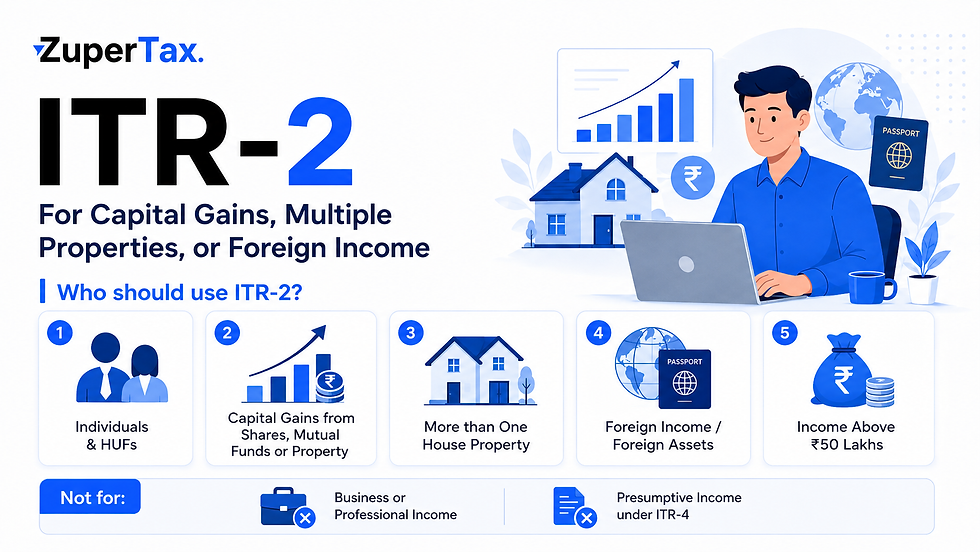
ITR-2:
For Capital Gains, Multiple Properties, or Foreign Income
ITR-2 is for individuals and HUFs who do not have income from business or profession, but have income such as:
Capital gains from shares, mutual funds, property, or other assets
More than one house property
Foreign income or foreign assets
Income above ₹50 lakhs
This year, many salaried people may have to file ITR-2 instead of ITR-1 because of capital gains.
For example, if you sold shares or redeemed mutual funds during FY 2025–26, you should download your capital gains statement before deciding your ITR form.
Do not assume that because you are salaried, ITR-1 is always enough.

ITR-4 Sugam:
For Freelancers, Consultants, and Small Business Owners
ITR-4 is for resident individuals, HUFs, and firms other than LLPs who have opted for presumptive taxation.
This usually applies to:
Small businesses under Section 44AD
Specified professionals under Section 44ADA
Goods transport operators under Section 44AE
For example, if you are a freelancer or consultant and your gross receipts are within the prescribed limit under Section 44ADA, you may be able to declare 50% of your gross receipts as profit without maintaining detailed books of accounts.
This makes ITR-4 useful for many consultants, freelancers, doctors, architects, engineers, accountants, designers, and other professionals.

But ITR-4 also has restrictions.
You cannot use ITR-4 if you have capital gains, foreign assets, income above the threshold, or if you are not eligible for presumptive taxation. In such cases, ITR-3 may be required.
Documents You Should Keep Ready Before Filing

Before filing your ITR, or before sending your documents to your tax consultant, keep everything ready in one place.
For salaried individuals, you may need:
Form 16 from your employer
Bank statements for FY 2025–26Form 26AS
AIS and TIS from the income tax portal
Interest certificates from banks and post officesHome loan interest certificate, if applicable
Rent receipts and landlord PAN, if claiming HRA
Investment proofs for deductions such as 80C, 80D, and 80CCD(1B), if choosing the old regime
For freelancers and consultants:
Invoices raised during the year
Bank statements showing receiptsTDS certificates, if clients deducted TDS
Form 26AS
AIS and TIS
Expense records, if books of accounts are maintained
For investors:
Capital gains statement from broker or mutual fund platform
CAMS/KFintech capital gains report
Details of shares, mutual funds, property, or other assets sold
Purchase cost and sale value details
Property documents, if property was sold
Having these documents ready will make the filing process faster and more accurate.
What Is Different for AY 2026–27?

There are a few points taxpayers should be careful about this year.
1. New Tax Regime is the Default Regime
The new tax regime continues to be the default option.
This means that unless you specifically choose the old tax regime, your return will be processed under the new regime.
This is important because deductions such as 80C, 80D, HRA, and home loan interest benefits are generally available under the old regime, not the new regime.
So before filing, compare both regimes and choose the one that gives you the lower tax liability.
2. Capital Gains Tax Rules Have Changed
After the Budget 2024 changes, long-term capital gains on listed equity shares and equity mutual funds are taxed at 12.5% on gains above ₹1.25 lakh. Short-term capital gains on such equity assets are taxed at 20%.
So, if you sold shares or redeemed mutual funds during FY 2025–26, your tax calculation may be different from previous years.
Do not ignore your capital gains statement.
3. AIS Has More Data Now
The Annual Information Statement now captures a lot of information from different sources such as banks, brokers, mutual funds, property transactions, TDS returns, GST data, and more.
Before filing, download your AIS and compare it with your own records.
If there is an error, give feedback on the portal before filing. Do not simply file your return without checking the mismatch.
Why You Should File Early

For most salaried individuals and non-business taxpayers, the usual due date is 31 July 2026. For non-audit business and professional taxpayers filing ITR-3 or ITR-4, the due date is 31 August 2026.
But waiting until the last few days is never a good idea.
In the final weeks, the e-filing portal usually becomes slow because many people try to file at the same time. If there is a mismatch in Form 26AS or AIS, you may not have enough time to correct it. If one document is missing, you may end up filing in a hurry.
And if you miss the due date, there can be consequences.
You may have to pay a late filing fee under Section 234F. You may also have to pay interest under Section 234A if tax is payable. In some cases, you may lose the ability to carry forward certain losses, such as capital losses.
That loss carry-forward benefit can be very important for investors and business owners.
If you are eligible for a refund, filing early can also help you receive the refund earlier.
So, there is no real benefit in waiting until the deadline.
A Special Note on AIS Mismatches
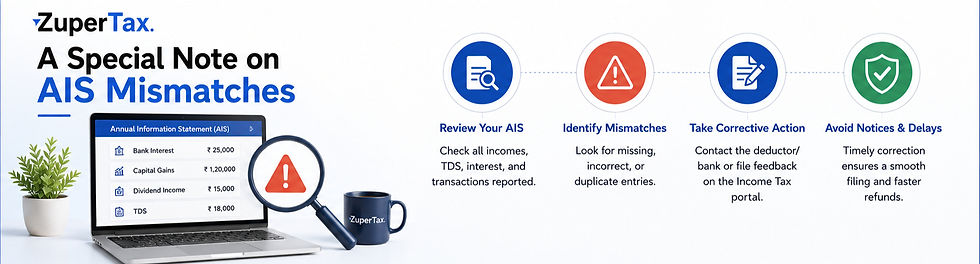
This year, please do not file your return without checking AIS.
I have seen cases where clients filed their ITR and later noticed that their AIS showed interest income, dividend income, or securities transactions that were not considered in the return.
This can lead to mismatch notices, defective return notices, or unnecessary follow-up later.
If your AIS shows an incorrect transaction, wrong amount, or income that does not belong to you, raise feedback on the portal.
It is always better to correct or report the mismatch before filing rather than dealing with a notice later.
Need Help Filing Your ITR?
At ZuperTax, we help salaried individuals, freelancers, consultants, investors, NRIs, and small business owners file their income tax returns accurately and on time.
You do not need to visit our office.
You can send your documents online. We will review your Form 16, AIS, Form 26AS, capital gains, deductions, and tax regime options. Then we will choose the correct ITR form and file your return properly.
Whether your case is simple or slightly complicated, we can help you file with confidence.
📞 +91 8129806355
Start early. File correctly. Avoid the last-minute rush.


Comments